
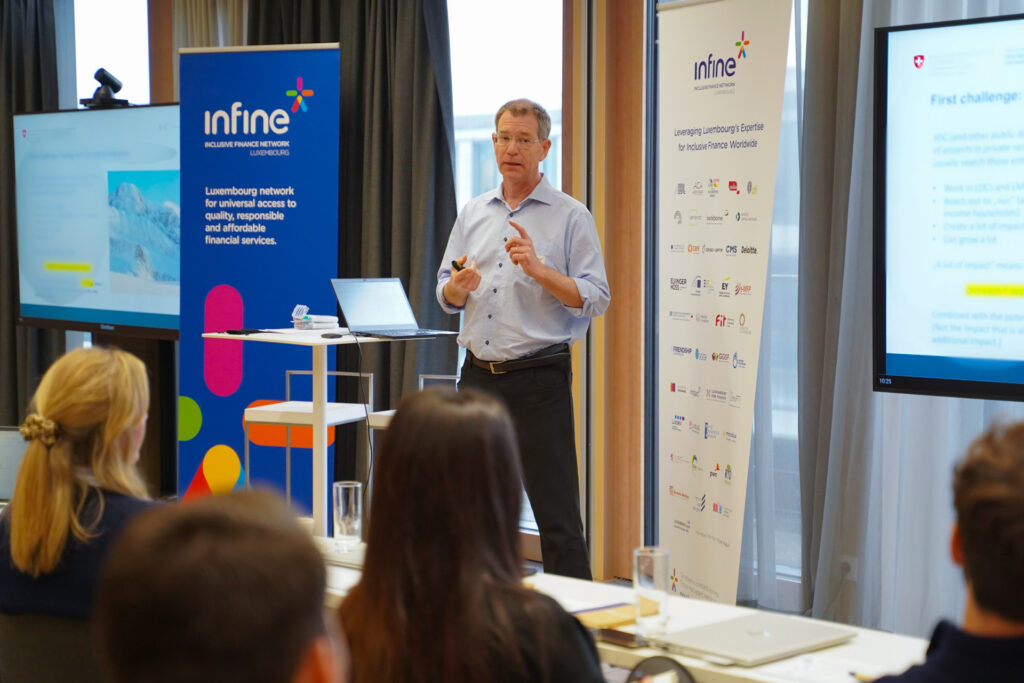
As part of InFiNe’s continued efforts to strengthen Luxembourg’s inclusive finance ecosystem, members gathered for a dedicated Training Day on Impact-Linked Finance (ILF). The session focused on a central question: how can we design fit-for-purpose capital structures that genuinely align financial incentives with measurable impact?
Bringing together members and non members of the impact finance ecosystem, the event created space for both strategic reflection and practical exchange. The objective was clear: move beyond conceptual discussions and explore how impact-linked mechanisms can be designed, implemented and scaled in a credible and operationally realistic way.
The training featured contributions from Roots of Impact, Grameen Crédit Agricole Foundation, and the Swiss Agency for Development and Cooperation (SDC), alongside active reflections from participants working across the inclusive finance landscape.
In this interview, conducted as a follow-up to the session, speakers and participants share key takeaways and practical insights for InFiNe members and Luxembourg-based organisations seeking to better understand, design and implement impact-linked mechanisms.
From your perspective, where does Impact-Linked Finance sit in today’s impact finance landscape?
It is a cross-cutting practice, as impact incentives can be embedded across the entire spectrum of impact finance. By its nature, it sits at the intersection of impact investing, blended finance, and results-based finance. Yet we should avoid presenting it primarily in technical terms. At its core, it is simply a mechanism to align incentives between investors and their investees – and to push beyond business as usual.
What lessons have emerged from early implementations?
We’ve published our lessons learned from eight years of Impact-Linked Finance practice, and I encourage anyone interested in this approach to take a look. It helps ensure the conversation starts from a well-informed foundation – and avoids repeating mistakes that have already been made. For a first transaction, my most important advice is this: keep the conversation non-technical and focus on shared goals. Start by discussing realistic impact targets with your investee. This is not primarily about measurement, but about building clarity around the key outcomes you want to achieve together. Once you’ve agreed on this, the rest becomes a matter of design.
In practice, what differentiates a credible impact-linked mechanism from a reputational or “impact-washing” exercise?
Independent evaluations have shown that well-designed Impact-Linked Finance works. But what does good design actually look like? To answer this question, we have developed the Design Principles for Impact-Linked Finance. They guide implementation and serve as a benchmark for the most effective use of this practice. In addition, an ILF Effectiveness Check will be available soon. It will be freely accessible, allowing anyone to evaluate their transaction design through a simple self-assessment
What makes ILF attractive compared to traditional impact investment?
From Grameen Crédit Agricole Foundation’s perspective, Impact-Linked Finance (ILF) offers several compelling advantages over traditional impact investment approaches.
One important factor is the direct alignment between financial terms and impact performance, which, in our case, strengthens our strategic focus on women’s empowerment and climate action. As demonstrated in our portfolio of €84 million across 69 partners in 37 countries, this approach allows us to pursue impact that directly aligns with our core mission.
Another key element is that ILF serves as a powerful tool for constructive dialogue with our partners. Through our sustainability-linked loans in India, Ivory Coast, Kosovo, and Uzbekistan, we’ve established frameworks that facilitate ongoing discussions about strategic impact issues, monitor achievements, and better understand our partners’ impact challenges.
Equally important, ILF incentivizes innovation among investees. By offering tangible financial benefits, we encourage partners to develop new products and services that advance social and environmental goals. This has led to innovations such as solar energy development in India and expanded financial services for women in Ivory Coast.
Ultimately, ILF enables us to offer better pricing to partners who demonstrate strong impact performance. This creates a virtuous cycle where financial incentives drive greater impact, which in turn enables more favorable financing terms. Our experience shows that even small incentives carry strong symbolic value and can significantly boost the deployment of impact-focused products.
What operational realities must investors take into account?
Based on our experience implementing sustainability-linked loans across multiple countries, several operational realities require careful consideration.
A critical starting point is technical assistance. Even large microfinance institutions often need support. Our work with Annapurna in India demonstrated that technical assistance is crucial for building robust business cases, identifying the optimal mix of products aligned with sustainability goals, and setting ambitious yet achievable KPIs for innovative products and services.
In addition, KPI selection and calibration must follow best market practices. We align with the Loan Market Association’s Sustainability-Linked Loan Principles, covering: (I) Selection of Key Performance Indicators, (II) Calibration of Sustainability Performance Targets, (III) Loan Characteristics, (IV) Reporting, and (V) Verification. This structured approach ensures credibility and effectiveness.
Progressive goal-setting is another essential dimension. Establishing incremental objectives provides partners with the necessary time to develop well-suited products and adapt their operations to meet long-term sustainability goals. For example, with Advans CI, we set gradually increasing targets for women’s financial inclusion over a five-year period.
Beyond that, investors must recognize the versatility of sustainability-linked mechanisms. Our portfolio demonstrates that these instruments can be applied to both existing products and newly conceived initiatives, making them adaptable to various stages of an organization’s impact journey.
Finally, KPI incentives function as management tools for operational teams. At Advans CI, linking financial terms to specific metrics such as the “percentage of women clients with access to multiple financial services” gave substance to quantitative objectives and helped drive organizational alignment around impact goals.
How do you balance robust impact measurement with investees’ reporting capacity?
Balancing robust impact measurement with investees’ reporting capacities requires a thoughtful, partner-centered approach based on our experience at Grameen Crédit Agricole Foundation.
We start by customizing impact metrics to align with our investment strategy while taking into account the operational realities of our partners. For example, with Advans CI in Ivory Coast, we selected just two focused KPIs related to women’s financial inclusion that were meaningful yet manageable for the institution to track and report.
Providing value-enhancing technical assistance is another key component. Supporting partners in developing appropriate systems for tracking and reporting impact data helps bridge the gap between ambitious impact goals and practical reporting capabilities.
We deliberately focus on a limited number of strategically selected KPIs rather than overwhelming partners with excessive reporting requirements. In our sustainability-linked loans, we typically use two to three impact KPIs (as with Kosovo) or up to five KPIs (as with Uzbekistan).
Clear reporting frameworks and verification processes aligned with international standards such as the Sustainability-Linked Loan Principles provide structure while keeping the reporting burden proportionate to the partner’s capacity.
More broadly, we view impact measurement as a collaborative learning process. Our sustainability-linked loans serve as “a real tool to discuss with partners strategic issues, monitor achievements and better understand their impact challenges.” This approach transforms reporting from a compliance exercise into a valuable strategic conversation that benefits both investor and investee.
This balanced approach has proven effective across our portfolio and forms the foundation of our new “Women Empowerment for Climate” fund, which will further embed gender and climate indicators to drive investee transformation.
What role can public actors play in de-risking and scaling ILF?
In 2015, SDC has jointly with Roots of Impact co-created Impact-Linked Finance. Since then, ILF has first been tested, piloted, then new innovations have been added, every year new projects and programmes have been started in different topics and geographies, new partners have been engaged, other donors have been convinced to co-finance. And the journey is still ongoing. Today SDC has some 10 ILF-projects, total budget of SDC about CHF 80M, and a multiple of this in co-finance form others. And this has leveraged investments into countries, sectors and investees, that now create impact that they would not have been able to create without ILF (additionality)!
ILF is applied without SDC, too, see Philippe’s responses. The ILF market survey 2024 came up with an estimate of a volume of USD 18B (investment and outcome payment), the WEF estimates the market at USD 35B. ILF is already at scale.
In addition, we co-finance different efforts for continued scaling:
This is where a public bilateral donor agency like SDC is hitting the ceiling. The ultimate push for scaling up could come from the public sector by regulation.
Think of the carbon market: obliging companies to reduce their negative externalities has been a great way of fighting climate change. What about obliging companies to create positive externalities? We could move from the output economy to the impact economy, i.e. instead of just producing more and more goods and destroying the environment, we could remunerate the production of impact like inclusion, improved wellbeing, biodiversity, achieving the UN Sustainable Development Goals. If you cannot create positive impact immediately yourself, you need to buy it from others who can. Social credits would follow the model of carbon credits, a huge market could be created.
With ILF we have shown the feasibility of this – bottom up.
Where do you see the greatest opportunity for public-private collaboration using impact-linked mechanisms?
Simple answer: there may be a business case for companies to buy impact, e.g. to stabilize value chains in cocoa or coffee. Obviously, if it would be a very profitable business case, it should already happen.
This is where the public sector comes in: co-finance identification of this kind of opportunities, close financing gaps and pay for public good character outcomes. Provide design funding for testing collaboration and for scaling.
The role of the public sector is not to replace the private sector and vice versa. It is about finding constantly new, innovative and effective ways of cooperation.
ILF is a very powerful tool here: we can identify cases of market failure where outcome buyers from private and public sector may jointly heal them.
So, there is a lot more to innovate and test.
How important is ecosystem coordination across donors, investors and intermediaries, for these mechanisms to succeed?
The most important impetus is creating massive demand for impact, ideally a market for impact. This will attract talent, ideas, innovation, technology, etc. and the institutions needed for a market (registries, etc.).
Therefore, we need
Last but not least, coordination is not falling from heaven. We need to organize it. The ILF Collaborative is a first step into this direction. However, as this coordination is a lot of work and has a lot of characteristics of a public good, we need to broaden the co-financing of the ILF Collaborative (https://ilfcollaborative.org/).

The Training Day also prompted reflection among participants
How did your understanding of ILF evolve during the session?
Bienvenido Batista, EY Luxembourg: Participants generally entered with a basic conceptual awareness but limited clarity on practical implementation. After the training, most reported a more
concrete understanding of design considerations, incentives, and operational requirements.
Josué Toho, AWALE Advisory: Before the training, I saw Impact-Linked Finance (ILF) as “just another instrument” in a fund manager’s toolbox. The presentations and group discussions were instrumental in helping me develop a clearer understanding of the concept of impact, particularly from a funding perspective. I now see ILF less as a financial instrument and more as a comprehensive approach: one that encompasses technical assistance, thoughtful design, and all the elements needed to align with the fundee’s strategy
How realistic is implementation in your organisation? What barriers exist?
B.B.: Many found implementation feasible but dependent on internal alignment and operational capacity. Common barriers included data constraints, governance processes, and uncertainty about appropriate risk-sharing structures.
J.T.: I work with entities on the receiving end of funding. From their perspective, particularly Tier 2 and Tier 3 MFIs, the main challenge lies in producing reliable data and effectively communicating their impact story. They are closest to the target population, they are already making that impact, yet their limited resources are often absorbed by day-to-day operations.
Rather than being seen as a prerequisite for accessing funding, impact measurement should progressively become an integral part of running the business. This shift requires buy-in and engagement at multiple levels – not only from management, but also from regulators and policymakers.
What internal constraints matter most?
B.B.: Data quality, incentive structures, and leadership buy-in were identified as the most influential factors. Risk appetite and the ability to adapt internal processes quickly also play significant roles.
J.T.: Within the microfinance industry and the broader inclusive finance ecosystem, the usual internal constraints apply: impact must be deeply embedded in the organisation’s strategy, internal policies and processes, objectives, and KPIs. However, it should go beyond being treated as a partnership checkbox or a regulatory compliance requirement. Instead, it needs to become as critical as managing credit risk or liquidity risk. Only then can it become sufficiently clear and tangible for funders to align with.
Across speakers, one clear message emerged for institutions considering their first impact-linked transaction:
Impact-Linked Finance is no longer experimental. It is evolving into a practical and credible approach to aligning capital with measurable outcomes.
The challenge ahead is not whether ILF works, but how thoughtfully and collaboratively it is implemented.
As we look toward 2026, the call to action is clear: Design with intention. Align incentives. Scale through collaboration.