
As part of InFiNe’s De-Risking Working Group, launched in 2025 to strengthen Luxembourg’s capacity to mobilise private capital for inclusive finance, members took part in a dedicated de-risking training session in June 2025. The session aimed to build a shared understanding of risk and risk-mitigation mechanisms in emerging markets, laying the groundwork for future Luxembourg-based de-risking solutions.
The training was led by Koen Wasmus, Founder of Wasmus Consulting, whose work focuses on supporting impact investors, fund managers, and financial institutions operating in high-risk and frontier markets. Drawing on extensive field experience, Koen guided participants through the risk universe faced by impact investors, explored practical approaches to credit, climate, country, and currency risk, and unpacked the realities, limitations, and costs of de-risking instruments.
In this interview, conducted as a follow-up to the session, Koen Wasmus shares key takeaways and practical insights for InFiNe members and Luxembourg-based organisations seeking to better understand risk, design effective de-risking strategies, and operate responsibly in inclusive finance.
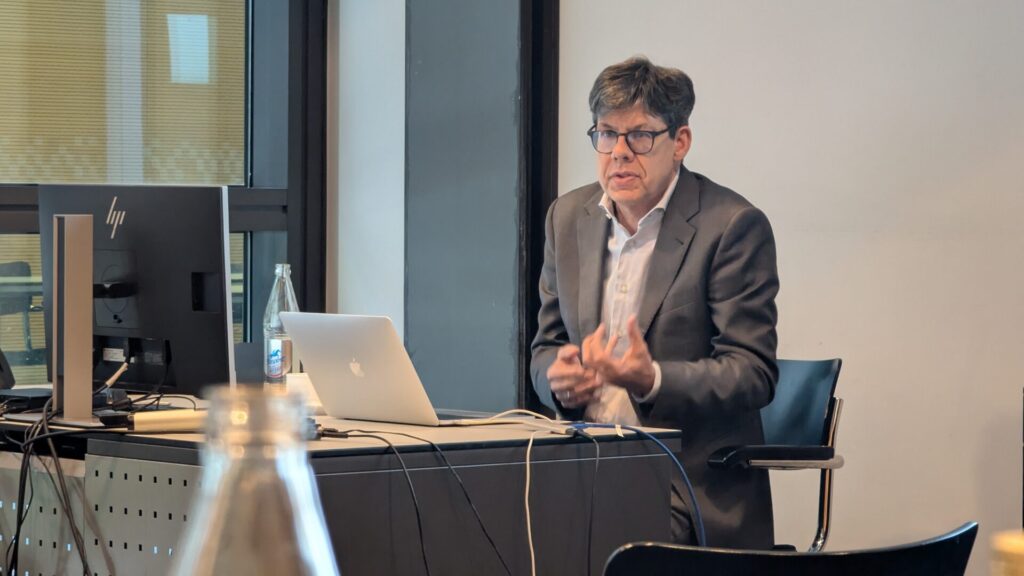
Koen, to start us off, could you tell us why de-risking is such a critical topic for impact investors today, especially in inclusive finance?
De-risking is getting a lot of attention these days as impact investors face increased levels of risk, in part due to multiple risks kicking in simultaneously. Investors are looking at ways to manage their risk at appropriate levels. De-risking is a bit of a misleading term as it not a magic wand that makes risk disappear. Rather, in most cases risk is transferred to a third party, for instance a guarantee provider or a government entity.
You presented a comprehensive “risk universe” for impact investors. For InFiNe members and Luxembourg-based organizations looking to enter this space, what are the most critical risks they should prioritize understanding and addressing first?
Climate risk is definitely on the rise, and the global south is hit hard by frequent occurrences of extreme weather events, changing rainfall patterns, and shifts in ecosystems. Geopolitical risk is also increasing on the back of supply chain disruptions due to COVID, wars in Ukraine, Sudan and Gaza and the havoc caused by the Trump Administration’s closure of USAID. Finally, many emerging market currencies are volatile, translating into FX risk.
Your research shows that impact investors are actively investing in countries across the risk spectrum. How should Luxembourg-based organizations approach country risk assessment beyond just looking at ratings – what other factors should they consider?
62% of private impact investments is placed in non-investment grade countries, indicating that impact investors are willing to look beyond just the ratings. Factors to consider include a country’s economic strength, its fiscal strength, its institutional strength (strong institutions reduce political risk and policy shocks), and the likelihood of sudden shocks and how well a country can absorb them. Interestingly, much of this information can be found in country rating reports. Finally, impact investors should pay particular attention to transfer risk, i.e. the investee’s inability to transfer funds out of the country (to repay the impact investor).
You outlined several different approaches to measuring credit risk, from loan loss reserves to default statistics. What practical advice would you give to impact investors about building robust credit assessment capabilities, especially when entering new markets or sectors?
The ability to adequately assess credit risk is key to the success of any investment. Investors still consider due diligence to be the most important risk mitigant. In their due diligence, it is advised that impact investors make good use of local knowledge either by maintaining a network of country offices, or by teaming up with local experts for the due diligence exercise. In addition, the credit assessment should focus on the repayment ability by conservatively projecting cash flows of the investee and, last but not least, consider the governance and management capacity of the business to be financed.
You demonstrated that climate risk impacts are measurable and vary significantly by country and region. How should investors start incorporating climate risk analysis into their investment processes, and what tools or resources would you recommend?
A good starting point is to understand the investee’s vulnerability to climate risk (line of business, location, supply chain, etc.). Second, it is advisable to make use of resources such a Germanwatch Climate Risk Index (CRI), a tool that that assesses historic climate related extreme weather events’ impacts on almost all countries. This helps understand to what extent a country has been affected in the past. In addition, there are country-based resources that look into the future, such as the World Bank Country Climate Risk publications.
Once the risk is understood, adaptation measures or mitigants can be identified and impact investors could consider including these in the investment package. For agriculture investments, think of irrigation, shade nets against heat stress and drought resistant planting materials. For other types of investments, relocation (e.g. to higher grounds) or diversification of supply chains may be considered.
Your analysis highlighted the significant challenges around currency risk management in impact investing. What key considerations should guide investors when deciding on their currency risk strategy, and what mistakes do you see investors making most often?
Currency losses can have a significant impact on an impact fund’s performance. Some impact investors are discouraged by the complexity and cost of currency hedging and may opt to lend in hard currency or not to hedge at all. Indeed, about two thirds of private impact investing is done in hard currency. This is fine if the investee can earn foreign exchange, for instance if it is engaged in exporting goods or services. However, if the investee only has local currency earnings, the forex risk is offloaded on the investee which poses ethical questions.
About a third of local currency funding remains unhedged. Brokers such as MFX can assist impact investors in finding the right solutions. And TCX, in cooperation with the EU, will be offering currency hedging at subsidized rates, expected from Q4 onwards.
You mapped out a wide range of de-risking instruments; could you walk us through the main categories? How should investors decide which instruments to use in which situations? Are there common mistakes you see in instrument selection?
Common derisking instruments include the use of first-loss capital and debt, guarantees and currency hedging instruments. First loss capital, often as part of a ‘blended finance’ arrangement, is typically built into fund design. Hence it can typically only be applied at fund inception. The use of first-loss or junior debt as part of a syndicated loan is much less common and can be useful to de-risk specific transactions. Guarantees are the most common form of de-risking instruments and come in many different flavors. Interestingly, there are guarantee instruments available that specifically target funds. Insurance is another well-known risk mitigant, but unfortunately political risk insurance is not readily available for impact investors. Finally, currency hedges can go a long way in addressing currency risk.
One trend that puzzles me is the stacking of de-risking mechanisms, for instance a fund manager that opts for a fund guarantee on top of a generous amount of first loss capital. One must ask oneself if the additional instrument really serves a purpose. At the end of the day, de-risking mechanisms are scarce goods, which bear costs, and the bill often ends up with investees.
You shared examples like the IDH Farmfit Fund and structured green bonds. What are the key design principles that made these de-risking mechanisms successful, and how can they be adapted to other contexts?
These innovative examples are built on the willingness and ability of one party to accept a junior risk position, a level of trust between different parties, and a good amount of perseverance and patience as these instruments take long to set up. But these efforts can pay off: the initial cooperation between IDH and an impact investor around a junior debt transaction led to a partnership which allows for expanding the use of junior debt as a way to reduce risk in high-risk transactions.
Based on your research and stakeholder interviews, what advice would you give to Luxembourg’s inclusive finance ecosystem about building stronger risk management capabilities and designing more effective de-risking strategies?
It is important to understand what risk appetite the fund’s investors have and how best you can operate within the set parameters. And understand the level of risk that you are exposed to. As mentioned before, a lot of risk is mitigated through proper due diligence. There are no shortcuts here! If you face high risk due to the types of countries in which you operate, vulnerability to climate risk, the currency you operate in etc., you can opt to apply de-risking instruments. But remember, they come at a cost. Aside from the fee, there is always the danger of moral hazard and adverse selection.
About Wasmus Consulting
Wasmus Consulting is a small management-consulting firm, based in the Netherlands. We specialize in supporting impact investors, banks and microfinance institutions (MFIs) that operate in emerging markets and transition economies. Our clients are both banks & MFIs as well as investors, fund managers & donors that promote financial inclusion. Since the start of the company in 2014, we implemented over 40 projects in 20+ countries. Our team consists of experienced practitioners who served in both executive and non-executive roles in prominent microfinance banks and MFIs. The core team is complemented by a pool of trusted consultants who all served as CEOs of microfinance banks/ MFIs or have experience as non-executive board members.
Projects for impact investors include multiple market studies for fund expansion into new geographies, work around sustainable agriculture (market studies and FI implementation) and design of risk management frameworks.
Photo © Inclusive Finance Network Luxembourg asbl