
By Pedro Pinheiro | 30/04/2026
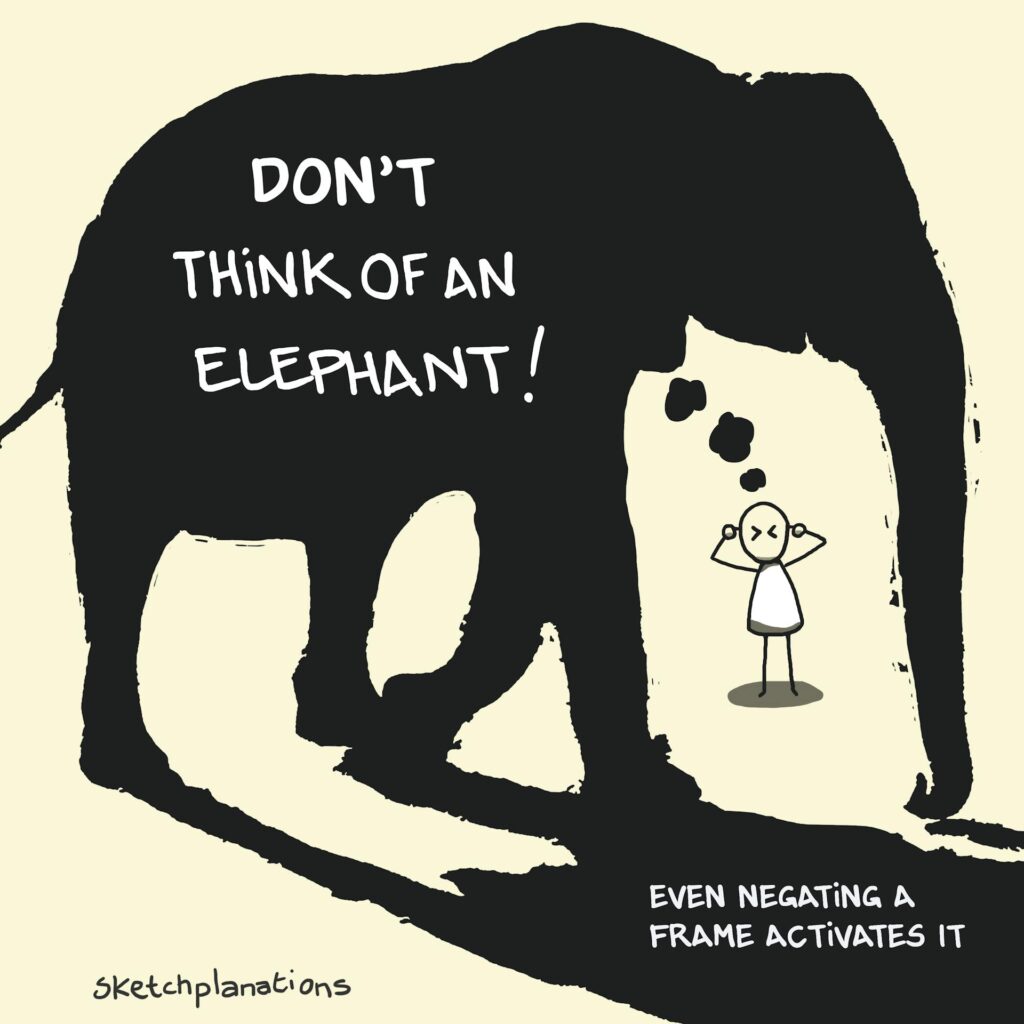
In one of the most widely read books on behavioural science, the American cognitive linguist and philosopher George Lakoff examines the power of “framing” in shaping social and political outcomes. He argues that human thought is grounded in the physiology of the brain, with roughly 98% of its activity operating at a subconscious level. As a result, much of our reasoning relies on relatively fixed mental structures (“frames”) that shape the goals we pursue, the plans we make, how we act, and how we judge outcomes as good or bad. Neuroscience has since reinforced this insight: once a frame is consistently activated, even attempts to negate it tend to reinforce it at a subconscious level. If someone tells you: Don’t Think of an Elephant! (the title of his book), the image that immediately comes to mind is precisely that of the animal.
These frames are activated through cognitive shortcuts that help the mind process complexity. One of these shortcuts the mind applies to make sense of the world is metonymy. It is common to take a familiar or easily perceived aspect of something and use it to stand for the whole or for a specific part of it. In English, a standard pattern is to use a place to represent the institution located there: “Brussels and London remain at odds over trade rules,” where “Brussels” stands in for the EU institutions and “London” for the British Government.
When applied to people, metonymy often draws on social stereotypes that shape expectations and enable us to form quick judgements. Consider the use of “mother,” which is often implicitly understood as a housewife, requiring a qualifier like “working mother” to signal a different reality.
When financial service providers refer to “the customer,” they are often invoking a similar metonymy that stands in for a target segment without capturing the diversity of individuals within it. In an economy of scale, it is neither feasible nor efficient to tailor every product or process to each individual. Yet the closer firms come to recognising these differences, the better they can serve their clients, strengthening uptake, loyalty, and ultimately, financial performance.
One way regulators have sought to ensure that firms take into account the specificities of individual customers is through the concepts of product governance and suitability. Under EU regulation MiFID II (Directive 2014/65/EU), for example, for investment and savings product governance applies at the design stage: firms are required to define a target market for each offering, ensure that its features, risks and costs are consistent with the needs and characteristics of that market, and distribute it accordingly.
Suitability, by contrast, refers to the obligation of a firm to ensure that a given product or service is appropriate for a particular client, taking into account the client’s knowledge and experience (including their understanding of risks), financial situation (including their ability to bear losses), and objectives and needs (including risk tolerance and time horizon). In practice, suitability is typically assessed at a later stage, when the product is recommended or provided to an individual client.
The concepts are applied in ways adapted to insurance and credit products. Still taking the EU as an example, the Insurance Distribution Directive (Directive (EU) 2016/97) requires product oversight and governance, as well as a demands and needs test, while the Consumer Credit Directive (Directive 2008/48/EC) focuses on creditworthiness and affordability assessments, as well as broader consumer protection measures. In developing markets, the situation varies: product governance and suitability may exist in principle but are often less formalised, although there is growing attention to integrating consumer protection frameworks into financial services regulation.
In inclusive finance, the reality is more complex and should warrant closer scrutiny by firms as well as greater regulatory attention. The broad categories typically used by the traditional market to define clients, whether they are women, entrepreneurs, smallholder farmers, or others, tend to be overly abstract, revealing little about the realities that shape financial behaviour of the actual clients. Beneath these labels sit highly diverse profiles, with markedly different income levels, exposure to risk, access to support networks, and stability of cash flows.
In practice, this gap between categories and realities has already forced providers to adapt. The Microinsurance Compendium is full of examples of how these abstractions can be broken down in practice to address specific constraints of low-income households. Premium payment schedules, for instance, are often made flexible to align with irregular and seasonal income streams, allowing clients to pay in smaller, more frequent instalments or at moments when cash is available. Product features are also simplified to reduce complexity and improve usability, with shorter contracts, clearer terms, and streamlined claims processes that limit documentation requirements and accelerate payouts. In some cases, benefits are adapted to client preferences, including in-kind services such as funeral arrangements or direct access to healthcare rather than lump-sum cash payments. Distribution models similarly reflect local realities, leveraging trusted intermediaries such as cooperatives, microfinance institutions, or community groups to build understanding and trust.
For microcredit, disbursement and repayment schedules are aligned with agricultural or business cycles, improving both uptake and repayment performance. Distribution models likewise reflect local conditions, relying on group lending, community-based mechanisms, or existing financial networks to overcome information gaps and build trust.
These examples point back to the same underlying issue. Even with the best intentions to be customer-centric, the moment we refer to “the customer,” we default to a frame that overlooks the specificities of the end client. Much like Lakoff’s elephant, the category imposes itself, flattening the diversity of realities it is meant to capture. Product governance and compliance introduce useful discipline, requiring firms to articulate who their products are for and why. But unless this is grounded in a closer understanding of clients, it risks becoming a formal exercise. The task is to ensure that design and compliance processes are anchored in lived realities to deliver better outcomes.
If you are interested in exploring this further, in 2025 the Microinsurance Network (MiN) partnered with Busara Center for Behavioural Economics to explore the application of behavioural science insights to inclusive insurance design. You can access the key outputs from this collaboration in the webinar recording available on YouTube.
This article was written by Pedro Pinheiro, Knowledge and Strategic Partnerships Manager at the Microinsurance Network, as part of the InFiNe Scholarship Programme 2025, to which he was selected. Learn more about the Scholarship Programme