
On 24 November, Luxembourg confirmed its growing role as a global hub for gender-inclusive finance as the European Investment Bank (EIB) hosted the conference Global Dialogue on Women’s Leadership and Gender-Inclusive Finance. Organised by the Alliance for Financial Inclusion (AFI) in partnership with the Ministry of Finance of Luxembourg, the event brought together senior representatives from central and international banks, development finance institutions, the IMF, investment funds, private sector actors and global networks, including members of the Inclusive Finance Network Luxembourg (InFiNe).
Held at the EIB headquarters, the conference opened with high-level interventions from the President of the EIB Nadia Calviño, Luxembourg’s Minister of Finance Gilles Roth, and AFI’s Chief Executive Officer Alfred Hannig. Their messages set a clear direction: advancing women’s leadership and gender-inclusive finance now requires coordinated, action-oriented solutions.
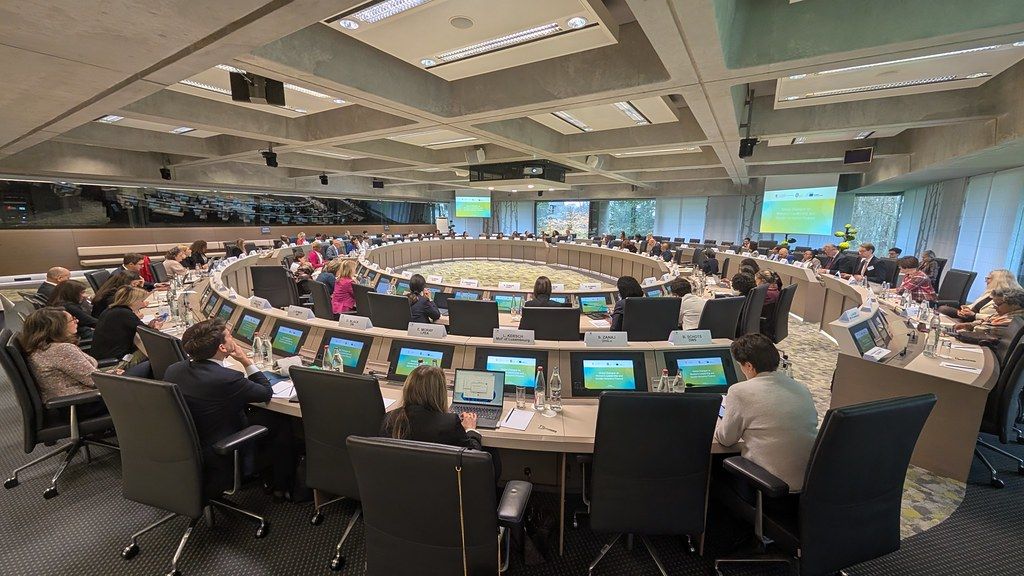
Luxembourg’s commitment to gender finance featured prominently throughout the discussions. The President of the EIB underlined the importance of strong partnerships to address global challenges such as climate finance, sea-level resilience and development finance, emphasising that collaboration is essential to building a credible and effective gender finance agenda. This commitment is reflected in the EIB’s significant engagement in gender finance through development banks and strategic partnerships, including within Luxembourg’s financial ecosystem.
Minister of Finance Gilles Roth reaffirmed gender finance as a strategic priority for Luxembourg’s Finance Centre of Excellence. He highlighted the work of the country’s dedicated Gender Finance Task Force and pointed to the EIB’s systematic integration of gender considerations across its operations as a key strength. Together, these efforts further consolidate Luxembourg’s positioning as a centre for inclusive and impact-driven finance.
While participants acknowledged the strong momentum behind gender-inclusive finance, discussions also highlighted the challenges that remain. One issue stood out across sessions: the need for reliable, gender-disaggregated data. Without it, policymakers and investors cannot accurately assess gaps, measure impact or design effective financial solutions.
The conference also reinforced the economic case for gender inclusion. Closing the gender gap is not only a matter of equity, but also a driver of growth. Estimates shared during the discussions suggest that reducing gender disparities could significantly boost global economic output, while investments focused on women can deliver competitive financial returns alongside measurable social impact.
Speakers stressed that access to finance alone is not sufficient. Financial products must be designed with women’s specific realities in mind and complemented by technical assistance and capacity-building initiatives. On the supply side, this requires an enabling mix of capital, innovative financial instruments, supportive regulation and technological solutions. On the demand side, women entrepreneurs and clients must be supported through financial literacy, skills development and business readiness programmes.
Mobilising capital remains particularly challenging in local currency lending, where operational costs are high. In this context, policy frameworks, blended finance structures and instruments such as gender bonds were highlighted as effective tools to reduce risk and attract private sector investment.
The conference also showcased concrete initiatives illustrating how Luxembourg’s ecosystem is contributing to gender-inclusive finance globally. Examples included the Female Entrepreneurship Fund in Central America and the Global Gender Smart Fund, both demonstrating how targeted financial solutions can support women entrepreneurs at scale.
These initiatives are backed by a strong community of InFiNe members, including ADA, CAMCO, EIB, LuxDev, Innpact, LHoFT, LuxFlag and AFI, reflecting the diversity and depth of expertise within Luxembourg’s inclusive finance ecosystem. The discussions also highlighted the growing convergence between climate finance and gender inclusion, underlining the importance of integrated approaches that address social and environmental challenges together.
In her closing remarks, the Director of the Inclusive Finance Network Luxembourg emphasised the importance of coordination across public, private and civil society actors to maximise impact and avoid fragmentation. She announced the upcoming Inclusive Finance and Impact Finance Luxembourg Ecosystem Mapping, scheduled to begin in 2026, which will provide greater visibility on ongoing initiatives and further strengthen Luxembourg’s role as a centre of excellence in inclusive and impact finance.
The conference concluded on a shared conviction: women’s access to finance is a powerful lever for leadership, economic participation and more inclusive and sustainable economic systems. Turning this ambition into tangible results will depend on continued collaboration, peer learning, digital innovation and data-driven approaches.
The quality of the exchanges among participants from across the globe once again highlighted Luxembourg’s unique position, and responsibility, in advancing gender-inclusive finance worldwide.
Photo © Giulia Iannucci